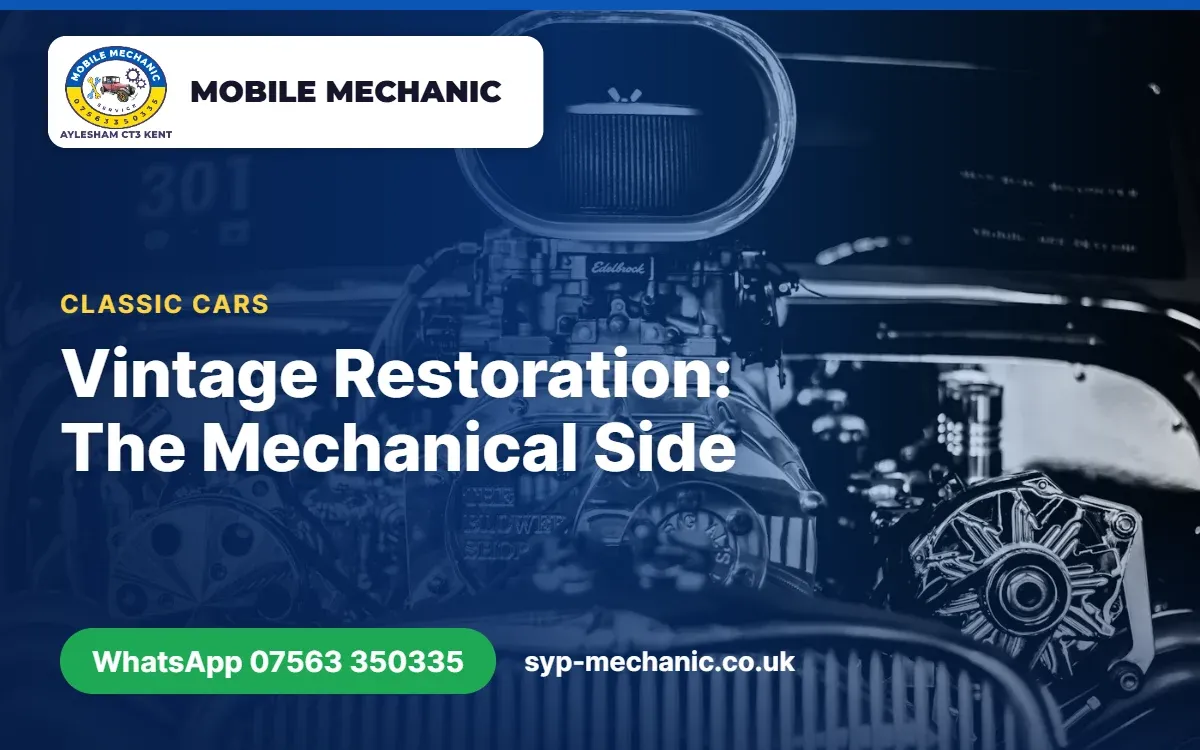
Vintage Car Restoration in Kent: The Mechanical Side
Written by Petro Olekhnovych, mobile mechanic in Aylesham, Kent
A vintage car restoration in Kent usually has two halves: the body and paint, and the mechanical work that makes the car safe and reliable to drive. We do the mechanical side. That means the engine, brakes, fuel system, cooling, electrics and bringing the car back into use, but not bodywork or paint.
What “mechanical restoration” means
A shiny car that will not stop, or boils over in traffic, is not finished. Mechanical restoration is about getting every working system back to a safe, dependable state.
Some owners want a full rebuild of everything. Others want the car made reliable while keeping as much original as possible. Both are valid. The plan should match how you want to use the car.
If you are having bodywork done elsewhere, it often makes sense to plan the mechanical work around it. That way parts are not fitted and then removed again.
Step 1: assessment
Every restoration starts with a careful look at what you have. Before any spanner turns, we check the condition of each system and make a list of what needs attention.
For a car that has not run for years, we do not just try to start it. We check oil, fuel, coolant and the ignition system first. Turning an engine over that has seized or has old fuel and fluids in it can cause damage that was not there before.
The assessment lets you decide what to do now and what can wait. It also gives a clearer idea of labour time before work begins.
Classic car needs some care?
Servicing, recommissioning and mechanical restoration for older cars across Kent.
WhatsApp for a free quote Call 07563 350335
Labour £30 to £50 per hour depending on the job. Send your reg number and we will reply with a price before any work starts.
Step 2: the engine
The engine is often the biggest job. Sometimes a service, new seals and careful setting up are enough. Smoke, knocking, low compression or heavy oil leaks can point to a full rebuild.
A full rebuild needs a clean workshop and time. We carry out classic engine rebuilds in a Kent workshop. Our guide to classic car engine rebuilds in Kent explains what that involves. We also work on air-cooled VW engines.
One legal point is worth knowing before you plan any changes. GOV.UK says vehicles built or first registered more than 40 years ago do not need an MOT, but only if no “substantial changes” have been made. Swapping the engine or chassis in a way that alters how the car works can count. If you are thinking of a non-original engine, check the GOV.UK rules first.
Step 3: brakes and safety systems
Brakes are the part we never cut corners on. On an older car, the whole system usually needs inspecting, not just the pads or shoes. That includes the pipes, hoses, cylinders and fluid.
Parts that have been standing can stick or seize. If a restored car pulls to one side, the pedal feels soft or the brakes drag, stop driving it and get it checked before going any further.
Step 4: fuel and cooling
Fuel systems suffer when a car stands. Old fuel can leave deposits in tanks, lines and carburettors. Cleaning or replacing parts of the fuel system is a normal part of restoration.
Fuel choice matters afterwards too. GOV.UK lists classic and older vehicles among those that may not be compatible with E10 petrol. For vehicles not on its checker, GOV.UK advises using E5 “super” grade petrol instead.
Cooling is the other big one. The FBHVC (Federation of British Historic Vehicle Clubs) recommends traditional IAT antifreeze for historic vehicles. It says long-life OAT coolant should only be used if the car used it when new or the manufacturer says so, as it can damage seals and gaskets in older engines.
If a car overheats during or after restoration, switch the engine off and let it cool. Do not keep driving.
Step 5: electrics
Old wiring can be brittle, corroded or bodged by previous owners. Electrical faults on a classic can cause anything from dim lights to a car that will not start. Careful fault finding is better than replacing parts at random.
Some classics also have positive earth systems or a dynamo instead of an alternator. These need to be understood before anything is connected or changed.
Step 6: recommissioning and first drives
Once the systems are done, the car needs bringing back into use in the right order. This is recommissioning: fresh fluids, checks on each system, a careful first start and then short test drives.
We explain the process in our post on recommissioning classic cars and steam engines. If you are still deciding whether to buy a project, our mechanical checklist for buying a classic car is a good place to start.
GOV.UK also reminds owners that an MOT-exempt car must still be kept roadworthy. Using a vehicle in a dangerous condition can mean a fine of up to £2,500 and 3 penalty points.
What affects the cost
There is no single price for a restoration. The cost depends on the car, its condition, how original you want it to be and how easy parts are to find. A car that has been well stored needs far less work than one that has stood outside.
Our labour is £30-£50 per hour, depending on the job and its difficulty. Parts are extra. For a deeper look at budgeting, see our post on what drives classic car restoration costs.
How we can help
We are a mobile mechanic based in Aylesham. Much of the mechanical work can be done where your car is kept, whether that is a garage, barn or driveway. Engine rebuilds are done in a Kent workshop.
We cover Canterbury, Dover, Deal, Sandwich, Folkestone and the villages in between. For classic owners we offer servicing and repair, fault finding, recommissioning, engine rebuilds and air-cooled VW engines. Read more about how we service classic cars at home across Kent.
We agree the price on WhatsApp before any work starts. We do not do bodywork or paint.
Frequently asked questions
Do you do bodywork or paint?
No. We do the mechanical side of a restoration only. If your car is with a body shop, we can plan the mechanical work around it.
Can you restore a car that has not run for years?
Yes. We assess it first and check each system before the engine is turned over.
Do restored classics need an MOT?
GOV.UK says cars built or first registered over 40 years ago are exempt, unless they have had substantial changes. They must still be kept roadworthy.
How much does a restoration cost?
It depends on the car and its condition. Labour is £30-£50 per hour plus parts, agreed on WhatsApp first.
Need help? Send a WhatsApp to 07563 350335 with your car’s make and model and we’ll come to you.
Classic car needs some care?
Message us on WhatsApp with your reg and postcode for a price before any work starts.
WhatsApp for a free quote Call 07563 350335
Labour £30 to £50 per hour depending on the job. Send your reg number and we will reply with a price before any work starts.
