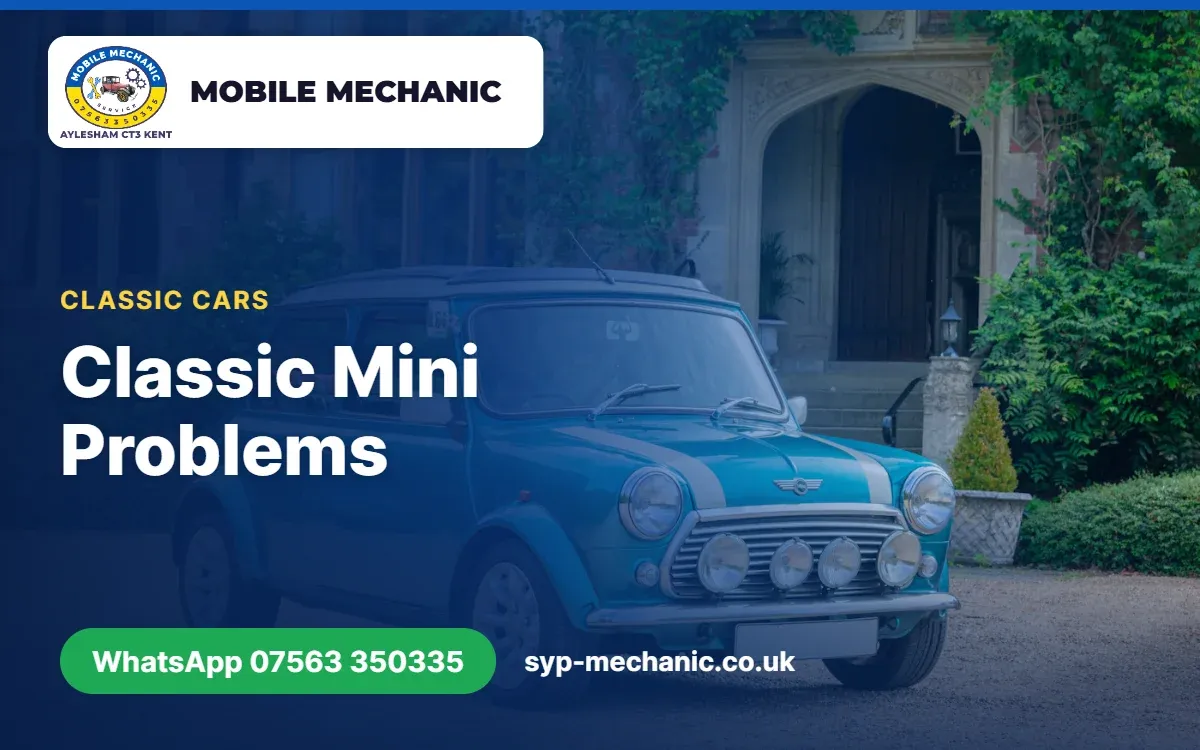
Classic Mini Problems: What Goes Wrong and How to Stay Ahead
Written by Petro Olekhnovych, mobile mechanic in Aylesham, Kent
The most common classic Mini problems are rust (especially the rear subframe, floors and sills), oil leaks from the A-series engine, gearbox wear, tired suspension and poor starting in damp weather. Most of these are manageable if you catch them early. Regular oil changes matter more on a Mini than on most cars, because the engine oil also lubricates the gearbox.
Rust: the Mini’s biggest enemy
Mini specialist Minisport puts it bluntly: classic Minis are renowned for corrosion. Its buying guide lists the main rot spots:
- Front inner wings, front valance and the wings around the headlights.
- Floors and sills, inner and outer.
- Boot floor, including the shock absorber mounts and spare wheel well.
- Rear subframe and the rear pockets.
- Door skins and frames.
- Scuttle and the area around the A-posts and the base of the windscreen.
Subframes. The Mini’s engine and suspension bolt to a front and rear subframe. Classics World notes that front subframes do not often corrode, because they tend to be coated in engine oil. The rear subframe is less well protected. Minisport calls rear subframe corrosion a common MOT failure.
Minisport also warns that poor past repairs can hide rust, so look under carpets and check panel gaps, sills and A-pillars.
If your Mini lives near the coast, salt makes all of this worse. Our post on coastal car rust checks explains how MOT testers judge corrosion.
The A-series engine: tough but leaky
Minisport describes the A-series as one of the most dependable and durable engines in classic cars. That does not mean trouble free.
Oil leaks. Minisport says Minis are notorious for oil leaks. Classics World names the rocker cover, driveshafts and gear selector rods as key leak areas. Keep an eye on the oil level between changes.
Smoke. Blue smoke on start-up or under acceleration can point to worn valve guides, valve stem seals, piston rings or bores, according to Minisport. Classics World says acrid blue smoke is a sign a rebuild is due.
Head gasket. Both guides say creamy deposits under the oil filler cap can point to head gasket trouble. Check the coolant level too, and get it looked at if the car has been overheating.
Timing chain and tappets. Minisport flags noisy timing chains and wrongly set valve clearances. A rattle or tapping that gets worse is worth getting checked.
When an A-series is worn out, a rebuild is often the right answer. We cover what that involves in our guide to classic car engine rebuilds in Kent.
Classic car needs some care?
Servicing, recommissioning and mechanical restoration for older cars across Kent.
WhatsApp for a free quote Call 07563 350335
Labour £30 to £50 per hour depending on the job. Send your reg number and we will reply with a price before any work starts.
Gearbox in the sump: why oil changes matter
On a classic Mini, the gearbox famously lives in the sump and shares the engine oil, as Classics World explains. That means old, dirty oil wears the gearbox as well as the engine.
Classics World calls the gearbox probably the most fragile mechanical part of a Mini. A little whine is normal, but hissing can mean worn bearings. Minisport adds that jumping out of gear and worn CV joints are things to watch for.
Oil change intervals vary by model and how the car is used, so check the handbook or ask us. Classics World suggests looking at the oil colour: black and old looking is a warning sign.
Suspension: rubber cones and Hydrolastic
Most classic Minis use rubber cone suspension, often called “dry” suspension. Minisport says it needs little maintenance. Cones do stiffen with age, though, and Classics World quotes a specialist advising that the front cones be changed every five to ten years.
Some Minis left the factory with Hydrolastic, or “wet”, suspension. Classics World says this ran from 1964 to 1969, and to 1971 on the Cooper S, Clubman and 1275GT. The displacers are interlinked front to rear. Minisport describes the system as fragile, so look for fluid leaks or a car sitting low on one corner.
Classics World also says replacement displacers are very hard to find, which is why many wet Minis have been converted to dry suspension.
A greased suspension is a happy one. Classics World advises checking the grease nipple on the rear suspension arms and keeping the front swivels greased.
Damp starts and wet weather cutting out
Many Mini owners know the feeling of a car that will not start on a damp morning, or cuts out in heavy rain.
On early Minis the distributor sits right behind the front grille. A first-hand account on Old Classic Car describes rain shorting out the ignition and stopping cars, until owners fitted a waterproofing kit to the distributor cap and coil.
Classic Mini parts specialist Mini Mania lists a damp distributor cap as a cause of bad starting, with the simple cure of drying it off and trying again. It also lists a cracked cap, faulty HT leads, worn points and a faulty condenser or coil.
Classics World notes that points and condensers can be poor quality these days, and that electronic ignition can cure the Mini’s reluctance to run in wet weather. We explain the pros and cons in our post on electronic ignition conversion.
If your Mini simply will not start, our guide to why a classic car won’t start walks through the checks in order.
How we can help
We service and repair classic and vintage cars, and we come to you. Find out more about our classic car mechanic service in Kent.
- Servicing. Oil and filter changes, ignition checks and greasing, done at your home or garage.
- Fault finding. Damp starting, misfires, smoke or noises. We find the cause and tell you what it needs.
- Engine rebuilds. For a worn out A-series, rebuilds are done in our Kent workshop.
- Rust and suspension. We do not do bodywork, but we can look over the subframes, floors and suspension and tell you honestly what we find.
We cover Aylesham, Canterbury, Dover, Deal, Sandwich, Folkestone and the villages in between. Labour is £30-£50 per hour depending on the job. Parts are extra, and we agree the price on WhatsApp before any work starts.
Frequently asked questions
Why does my classic Mini leak oil?
The A-series is known for it. Common spots are the rocker cover, driveshaft seals and gear selector rods. Keep the level topped up between changes and get any heavy leak checked.
How do I know if my Mini has Hydrolastic suspension?
Hydrolastic cars use interlinked fluid displacers rather than rubber cones. Classics World says they were fitted from 1964 to 1969, and later on some models. Many have since been converted, so the car itself is the best guide.
Is rear subframe rust dangerous?
It can be. The rear suspension mounts to it, and Minisport calls it a common MOT failure. If you see heavy rust, have it inspected before driving far.
Need help? Send a WhatsApp to 07563 350335 with your car’s make and model and we’ll come to you.
Classic car needs some care?
Message us on WhatsApp with your reg and postcode for a price before any work starts.
WhatsApp for a free quote Call 07563 350335
Labour £30 to £50 per hour depending on the job. Send your reg number and we will reply with a price before any work starts.
