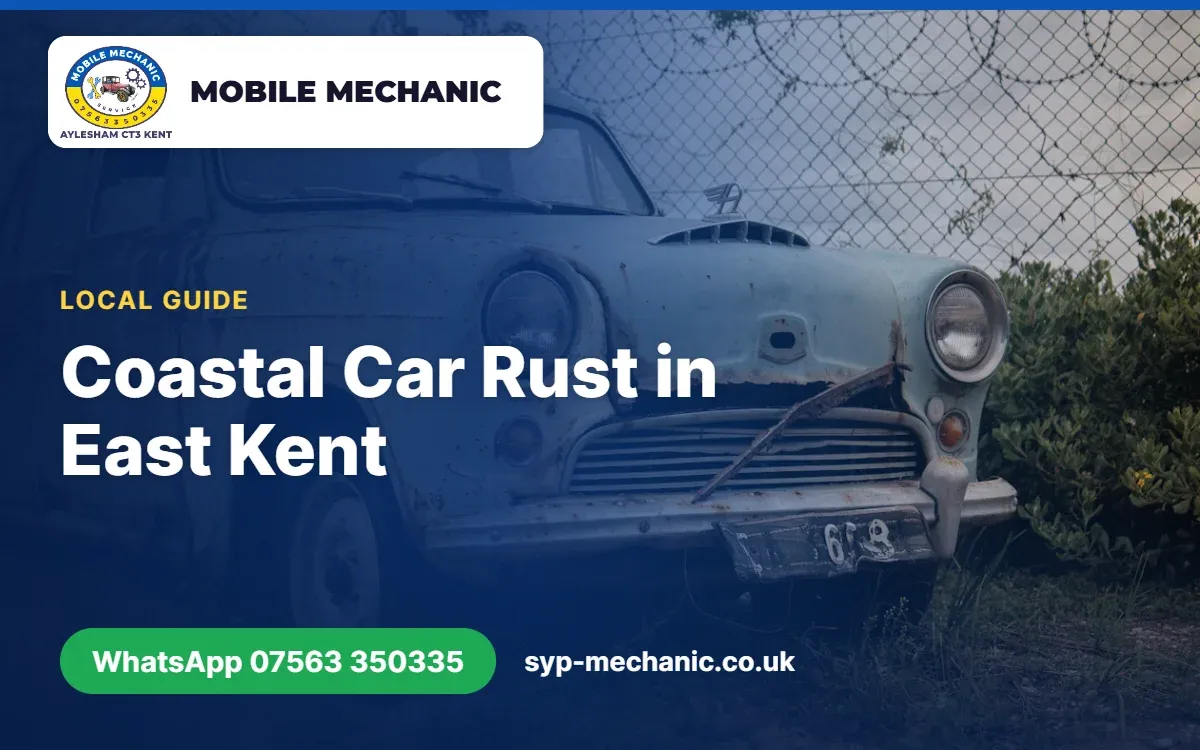
Coastal Car Rust: What to Check in Deal, Dover and Folkestone
Written by Petro Olekhnovych, mobile mechanic in Aylesham, Kent
Car rust is a bigger worry on the coast because salt speeds up corrosion, and cars parked near the sea are more exposed to it. The parts that matter most are the ones you cannot see: brake pipes, the underbody and the mounting points for suspension and steering. Surface rust on a panel is cosmetic, but rust in those areas can fail an MOT or make the car unsafe.
Why coastal cars rust faster
Rust forms when moisture and oxygen meet bare metal. Salt is corrosive and makes the problem worse. Classic car insurer Footman James warns that salt can cause significant rust to essential parts on a car’s underside, and that cars kept close to the sea are more exposed to the elements.
If you live or park in Deal, Walmer, Dover, Sandwich or Folkestone, your car gets salt from two directions. There is salty air and spray from the sea, and in winter there is salt spread on the roads. Both end up in the same places: under the car, inside the wheel arches and in seams that hold water.
The parts that rust first
Brake pipes. Most cars have metal brake pipes running along the underside. They carry the fluid that applies your brakes. If a pipe corrodes through, you can lose braking. This is the most important rust check on any car.
Brake hose ends. The flexible rubber hoses near each wheel have metal ends (ferrules) that can also corrode.
Sills and floor. The sills run under the doors. On many cars they are load-bearing, so rot here can be a structural problem, not just a cosmetic one.
Suspension and subframe mountings. The metal around where suspension, steering and brake parts bolt on takes a lot of load. Corrosion here matters more than anywhere else on the body.
Wheel arches. These take the brunt of the salty water thrown up by the tyres.
Need a mobile mechanic in East Kent?
Based in Aylesham, we come to your home or work across Canterbury, Dover, Deal and nearby villages.
WhatsApp for a free quote Call 07563 350335
Labour £30 to £50 per hour depending on the job. Send your reg number and we will reply with a price before any work starts.
How the MOT judges corrosion
The DVSA’s MOT inspection manual is clear that not all rust is a fail. Here is what it says about the key areas.
Brake pipes. A rigid brake pipe that is “damaged or excessively corroded” is a major defect, which means an MOT fail. The manual says a pipe whose wall thickness has been reduced by a third through corrosion, chafing or damage justifies rejection. The manual notes that a third is only about 0.25mm on a typical pipe, so it is hard to judge by eye. Brake hose ferrules that are excessively corroded are also a major defect, or dangerous if likely to fail.
Structure. Testers look at “prescribed areas”. These are load-bearing parts where testable items are mounted, plus any load-bearing structure within 30cm of those mounting points. In those areas, corrosion fails if it has made a hole, if the metal does not feel firm when pressed with finger and thumb, or if pressure or the tester’s corrosion tool makes a hole.
If the structure is corroded so much that steering or braking is likely to be affected, that is a dangerous defect.
Sharp edges. A body panel that is corroded and likely to cause injury if someone brushes against it is a major defect.
Advisories. Testers are told to mention corrosion that is not bad enough to fail. If your MOT certificate lists corrosion as an advisory, treat it as an early warning. Our guide to MOT advisories explains what to do with them.
Repairs. The manual says body filler is not an acceptable repair on load-bearing parts. Welded repairs must reach sound metal. So covering structural rust with filler will not get a car through.
Simple checks you can do
You do not need to get under the car to spot early signs.
Look along the bottom of the doors and the sills for bubbling paint.
Check inside the wheel arches with a torch.
Look under the car where you park for any brake fluid drips, which can mean a leaking pipe.
Notice any change in the brake pedal. If it feels soft, sinks or the car pulls, stop driving and get it checked.
Read your last MOT certificate for corrosion advisories.
How to slow rust down
Footman James suggests jet washing the underside of the car whenever you can to remove salt, and using an underbody wax product to keep rust at bay. It also suggests filling holes and crevices where water and salt can get in.
Washing matters most after winter, when road salt has built up. If your car lives near the seafront, a regular rinse of the underside and wheel arches is worth the effort. For a car that is laid up over winter, see our classic car winter storage guide.
How we can help
We are a mobile mechanic based in Aylesham and we come to your home or workplace across East Kent, including our mobile mechanic service in Deal and Walmer, Dover, Sandwich and Folkestone.
We do not do bodywork or welding. What we can do is come out, look at the underside, brake pipes and mounting points, and tell you honestly what we find and what it needs. A pre-MOT check is a good time to do this, so there are no surprises on test day.
Labour is £30-£50 per hour depending on the job. We agree the price with you on WhatsApp before any work starts. Parts are extra.
Frequently asked questions
Will surface rust fail my MOT?
Not usually. In prescribed areas, corrosion fails when it has made a hole or the metal feels soft. Surface rust that is still firm may be noted as an advisory.
Is it safe to drive with rusty brake pipes?
If a pipe is heavily corroded, it can burst and you could lose braking. If you see heavy rust on brake pipes, or the pedal feels wrong, stop driving and have it checked.
Do cars near the sea really rust faster?
Salt speeds up corrosion, and cars near the coast are more exposed to it. Regular washing of the underside helps.
Can rust be patched with filler for the MOT?
Not on load-bearing parts. The MOT manual says body filler is not acceptable there. Repairs must be properly welded to sound metal.
Need help? Send a WhatsApp to 07563 350335 with your car’s make and model and we’ll come to you.
Areas we cover: based in Aylesham, we come to you in Canterbury, Dover, Deal and Walmer, Sandwich and Ash, Folkestone, Wingham, Bridge and Barham, Shepherdswell, and Adisham. See all areas.
Need a mobile mechanic in East Kent?
Message us on WhatsApp with your reg and postcode for a price before any work starts.
WhatsApp for a free quote Call 07563 350335
Labour £30 to £50 per hour depending on the job. Send your reg number and we will reply with a price before any work starts.
