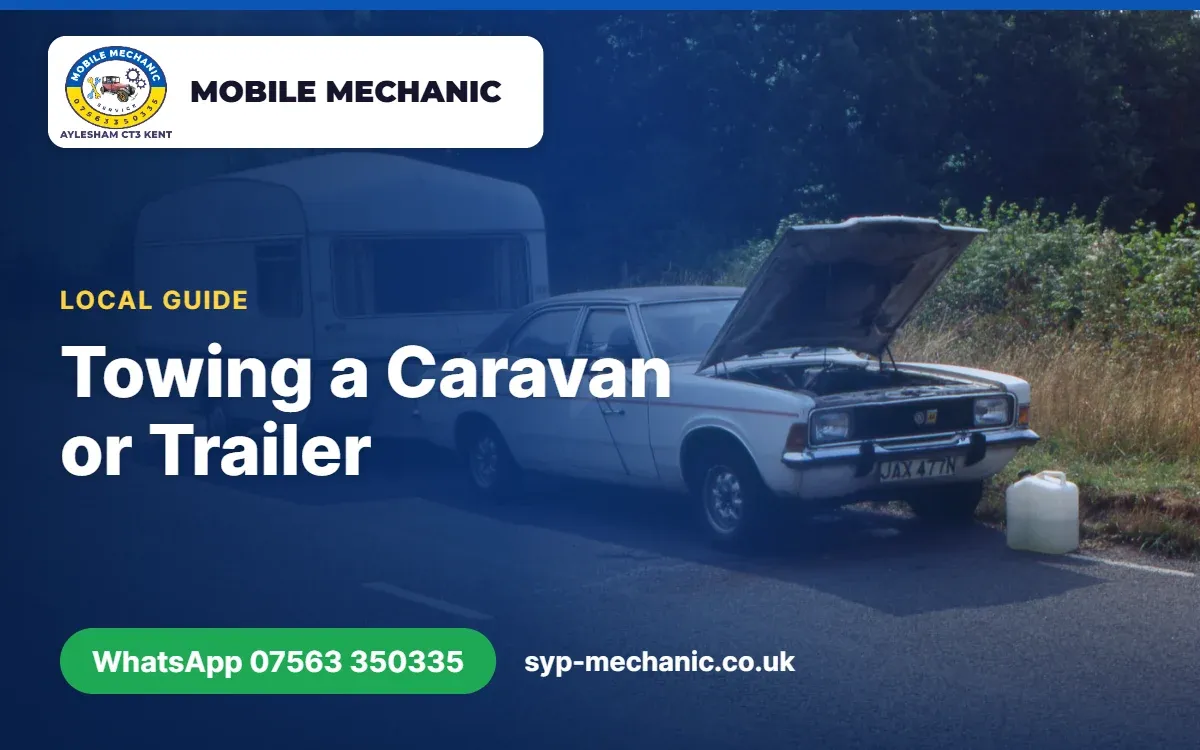
Towing a Caravan or Trailer: Car Checks and Rules
Written by Petro Olekhnovych, mobile mechanic in Aylesham, Kent
The key car checks before towing are your licence and weight limits, the nose weight, tyres on both car and trailer, lights, mirrors and brakes. Get these right and you are legal and far safer. Get one wrong and you risk a fine, penalty points, or a trailer that snakes out of control.
Can your licence tow it?
GOV.UK sets out the current rules:
- Licence from 1 January 1997: you can tow a trailer up to 3,500kg maximum authorised mass (MAM). This is category BE. If BE is missing from your photocard, DVLA adds it when you next renew.
- Licence before 1 January 1997: you can usually drive a vehicle and trailer with a combined weight of up to 8,250kg MAM.
MAM is the most the vehicle or trailer can weigh when fully loaded. It is in the owner’s manual and usually on a plate or sticker.
Can your car tow it? Weights and limits
Your licence is only half of it. The car has its own limits.
- Towing limit. Most cars have a maximum towing weight in the handbook or specification sheet.
- Gross train weight. This is the weight of the loaded car plus the loaded trailer. It may be on the VIN plate, normally under the bonnet or inside the driver’s door. GOV.UK says if your VIN plate does not list a train weight, you should not use the car for towing.
- Unbraked trailers must not weigh over 750kg, and should not weigh more than 50% of your car’s weight.
- Braked trailers: the car and loaded trailer must not weigh more than the second weight shown on the manufacturer’s plate.
- Size: the maximum trailer width is 2.55 metres. If your car’s MAM is 3,500kg or less, the trailer cannot be longer than 7 metres, not counting the A-frame.
Remember that luggage, passengers and fuel all count towards the car’s weight.
Need a mobile mechanic in East Kent?
Based in Aylesham, we come to your home or work across Canterbury, Dover, Deal and nearby villages.
WhatsApp for a free quote Call 07563 350335
Labour £30 to £50 per hour depending on the job. Send your reg number and we will reply with a price before any work starts.
Nose weight and loading
Nose weight is the downward force the trailer coupling puts on your tow ball. The Highway Code says you should keep a downward load on the tow ball to help stop the trailer swerving or snaking.
The Caravan and Motorhome Club gives a general guide of 5-7% of the caravan’s actual laden weight. Never go over the nose weight limit in your car’s handbook. You can measure it with a nose weight gauge, or with bathroom scales and a piece of wood under the coupling head.
Tips from the club:
- Check nose weight at the start of each trip.
- If the caravan tilts backwards, move heavier items forwards.
- If it tilts forwards, move heavy items to just behind the axle.
- Nose weight drops as speed rises, so make sure it is enough when standing still.
Spread heavy items over the axle and make sure the load is secure and nothing is sticking out dangerously.
Car and trailer checks before every trip
Tyres. Check every tyre on the car and the trailer. Each needs at least 1.6mm of tread across the central three-quarters, all the way round. Look for cuts and bulges. Inflate them to the maker’s pressure for the load being carried, as given in your handbook. Caravan and trailer tyres often do few miles and age faster, so check their date codes too. Our guide to tyre age and date codes explains how.
Wheel nuts. Make sure they are tightened to the correct torque.
Lights. Check there is no damage and that every trailer light works, including indicators and brake lights. Check the 7 or 13 pin cable and plug are not damaged.
Coupling. Make sure the trailer is properly coupled to the tow ball, following the maker’s advice, and that the coupling height is right.
Breakaway cable. You must use a breakaway cable or secondary coupling. Check it is not worn, has enough slack not to apply the brakes by accident, and will not drag on the road.
Number plate. The trailer must show the same number plate as the towing car.
Tow bar. If your car was first used on or after 1 August 1998, the tow bar must be type approved for your car. It should carry a label with an approval number.
Mirrors, brakes and cooling
Mirrors. You must have an adequate view of the road behind. If the caravan or trailer is wider than the back of your car, fit towing mirrors. Towing without proper mirrors can mean a fine of up to £1,000 and 3 penalty points.
Trailer brakes. A trailer over 750kg loaded must have working brakes, and any brakes fitted must be in good order.
Car brakes. The Highway Code warns that stopping distances may be much longer when towing. Your car’s brakes are doing far more work, so worn pads or discs matter even more. Our guide to brake pad warning signs covers what to look and listen for.
Cooling. Pulling a heavy load makes the engine work harder, especially on hills. Keep an eye on the temperature gauge. If it climbs towards hot or a warning light comes on, pull over safely and stop the engine. Do not keep driving. See what to do if your car is overheating.
Using a vehicle or equipment in a dangerous condition can mean a fine of up to £2,500, a driving ban and 3 penalty points, so it pays to check before you set off.
On the road: speed limits and snaking
Towing speed limits are lower than for a car alone:
- 30mph in built-up areas in England (20mph in Wales)
- 50mph on single carriageways
- 60mph on dual carriageways and motorways
You must not use the right-hand lane of a motorway with three or more lanes. If the trailer starts to snake, ease off the accelerator and slow down gently. Do not brake harshly.
How we can help
Before the towing season, we can come to your home or workplace and check the parts of your car that towing works hardest. We do brake pads and discs, oil and filter changes, servicing, water pumps and fault finding on warning lights. We do not fit tow bars or tyres, but we can tell you if your tyres need replacing.
We cover Aylesham, Canterbury, Dover, Deal, Sandwich, Folkestone and the villages around them. See the full list on our page about our mobile mechanic service across Kent. Labour is £30-£50 per hour depending on the job, parts are extra, and we agree the price on WhatsApp before any work starts.
Frequently asked questions
Can I tow a caravan on a normal car licence?
If you passed from 1 January 1997, you can tow a trailer up to 3,500kg MAM, as long as your car is allowed to tow that weight.
Where do I find my car’s towing limit?
In the handbook or specification sheet, or the gross train weight on the VIN plate. No train weight on the plate means the car should not tow.
Do I need towing mirrors?
Yes, if the caravan or trailer is wider than the rear of your car or blocks your view behind.
Does a small trailer need brakes?
Only if it weighs over 750kg when loaded. Brakes on smaller trailers are optional, but must work if fitted.
Need help? Send a WhatsApp to 07563 350335 with your car’s make and model and we’ll come to you.
Need a mobile mechanic in East Kent?
Message us on WhatsApp with your reg and postcode for a price before any work starts.
WhatsApp for a free quote Call 07563 350335
Labour £30 to £50 per hour depending on the job. Send your reg number and we will reply with a price before any work starts.
