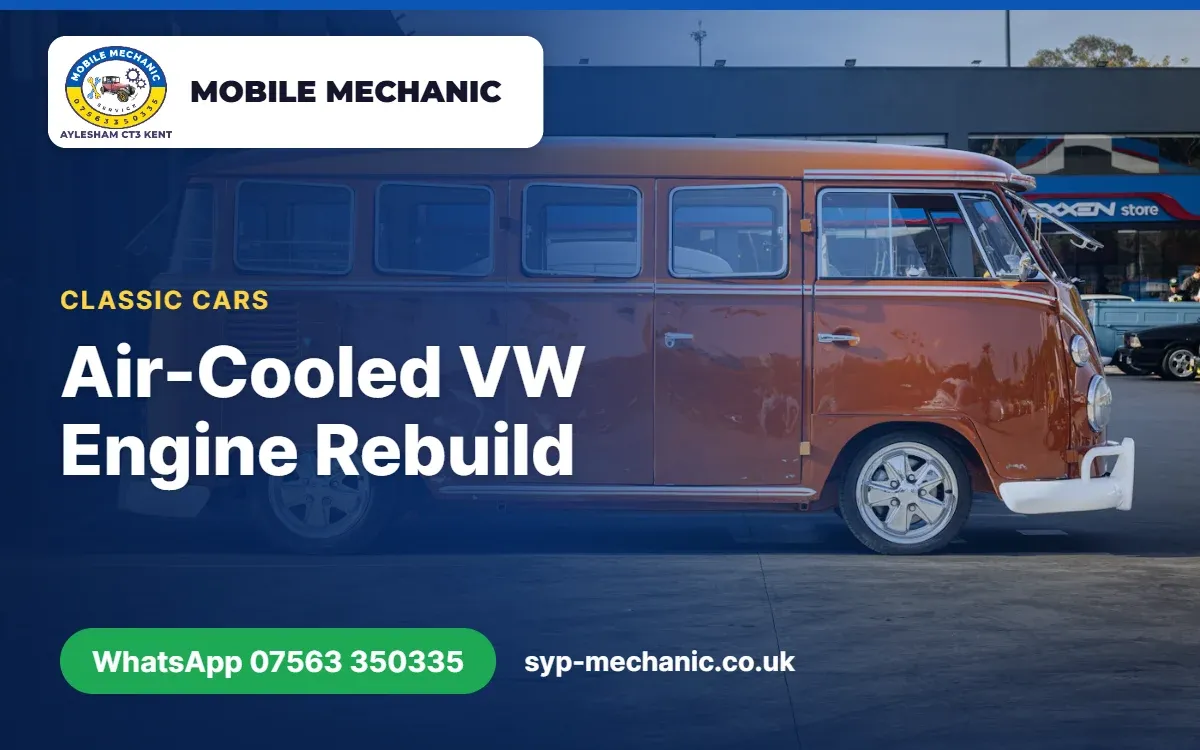
Air-Cooled VW Engine Rebuild: Signs It's Due
Written by Petro Olekhnovych, mobile mechanic in Aylesham, Kent
The clearest sign an air-cooled VW engine rebuild is due is noticeable back and forth movement at the crank pulley, which classic car magazines say means excessive crankshaft end float. Low or uneven compression, blue smoke, knocking and an oil light that is slow to go out are other warnings. One sign alone does not always mean a rebuild, so test properly before you decide.
This guide covers the classic air-cooled flat four found in Beetles, Campers and Karmann Ghias. Engine types and specifications vary, so always check the workshop manual for your engine.
Crankshaft end float: the big one
End float is how far the crankshaft can slide forwards and backwards along its length. A small, set amount is normal. On these engines it is set with shims behind the flywheel.
You can do a rough check yourself with the engine off. Hold the crank pulley and push and pull it in line with the crankshaft. Practical Classics says noticeable back and forth movement there means excessive end float, and that “an imminent re-build is needed”. Classics World says the same movement points to thrust bearing wear and the need for a rebuild.
A hand check only tells you something may be wrong. A proper measurement needs the right gauge. If end float is confirmed as excessive, stop using the car until it has been assessed, as the wear will not fix itself.
Oil leaks: worn out or just tired seals?
Some weeping is common on an air-cooled VW engine, and not every leak means a rebuild. Classics World lists the rocker covers, pushrod tubes and crankshaft oil seal as the usual sources. A crankshaft seal leak shows as drips between the engine and gearbox, and fixing it means taking the engine out.
Pushrod tube seals are a smaller job. Rancho Transaxles, a VW specialist, says they can be replaced with the engine in the car.
What matters is the pattern. A new leak from the flywheel end on an engine that also has end float, smoke or low compression is part of a bigger picture. A dripping rocker cover gasket on an otherwise healthy engine is not.
Classic car needs some care?
Servicing, recommissioning and mechanical restoration for older cars across Kent.
WhatsApp for a free quote Call 07563 350335
Labour £30 to £50 per hour depending on the job. Send your reg number and we will reply with a price before any work starts.
Compression and leak-down tests
A compression test shows how well each cylinder seals. It is one of the best ways to tell a tired engine from a worn-out one.
VW specialist Ratwell says a new engine with normal compression reads around 135 psi per cylinder. It says that as the engine ages, readings dropping to 71-85 psi mean a top end rebuild is needed. It also notes that wrong valve adjustment lowers the reading, so valve clearances should be set first.
The spread between cylinders matters as much as the numbers. Ratwell says uneven compression will make the engine shake.
A leak-down test goes further. Ratwell says a good engine should lose no more than 10% from each cylinder, with very little variation. Where the air escapes points to the cause: the oil filler for the piston rings, the carburettor for an inlet valve, or the tailpipe for an exhaust valve.
Smoke and oil use
The RAC says bluey-grey smoke under acceleration is a tell-tale sign of damaged piston rings, which let oil into the cylinders. Worn valve stem seals can also let oil leak in.
Not all smoke comes from the exhaust. On a flat four, oil leaking onto hot exhaust parts can smoke too. Rancho Transaxles describes leaking pushrod tube seals doing exactly this. So find where the smoke is coming from before you assume the worst.
Keep an eye on how much oil you are adding between changes. A rise in oil use alongside blue smoke is a strong hint the rings or valve guides are worn.
Knocks, clatter and the oil light
Ratwell says knocking is not normal and the engine should be shut down straight away. Classics World says to listen for clattering valve gear, though loose valve clearances can cause a tapping noise without the engine being worn out.
Watch the oil light at start-up. Ratwell says it must go out within about five seconds of the engine starting, or damage may occur. It also says falling oil pressure over time indicates bearing wear.
If the oil light comes on while driving, the RAC’s advice is to stop as soon as it is safe and switch off the engine. Check the level, but do not drive on if the level is fine and the light stays on.
Top end or full rebuild?
A top end rebuild deals with the cylinder heads, barrels and pistons. It suits an engine with low compression but a healthy bottom end. A full rebuild means splitting the crankcase to deal with the crankshaft, bearings and thrust faces.
Excessive end float, knocking or low oil pressure point to the bottom end, so a top end job alone will not fix them. Regular care helps an engine last, so see our guide to air-cooled VW servicing and our list of common VW Beetle problems.
What a rebuild costs depends on what is worn, how many parts need replacing or machining, and whether you want any upgrades. We cannot price it without inspecting the engine.
How we can help
We work on air-cooled VW engines as part of our classic and vintage car servicing across Kent. We are mobile, so we can come to your home or workplace in Aylesham, Canterbury, Dover, Deal, Sandwich, Folkestone and the villages around them.
We can check end float, run compression tests and look for leaks to tell you whether your engine needs a rebuild or just some attention. If it does need rebuilding, we do classic engine rebuilds in our Kent workshop.
Labour is £30-£50 per hour depending on the job and its difficulty. Parts are extra. We agree the price with you on WhatsApp before any work starts.
Frequently asked questions
Does an oil leak mean my VW engine needs rebuilding?
Not always. Rocker cover and pushrod tube leaks are common and can be fixed on their own. Leaks alongside end float, smoke or low compression are more serious.
Can I check end float myself?
You can feel for noticeable movement by pushing and pulling the crank pulley. A proper measurement needs the right gauge.
Is it safe to drive with excessive end float?
Avoid it. Practical Classics says it means a rebuild is imminent. Get the engine assessed before using the car further.
What compression should an air-cooled VW have?
Ratwell quotes around 135 psi per cylinder for a new engine. Check your engine’s specification and compare cylinders against each other.
Need help? Send a WhatsApp to 07563 350335 with your car’s make and model and we’ll come to you.
Classic car needs some care?
Message us on WhatsApp with your reg and postcode for a price before any work starts.
WhatsApp for a free quote Call 07563 350335
Labour £30 to £50 per hour depending on the job. Send your reg number and we will reply with a price before any work starts.
Sources
- Practical Classics: VW Beetle 1965-1978 buyer’s brief
- Classics World: VW Beetle buying guide
- Ratwell: Comprehensive engine inspection
- Rancho Transaxles: Replacing leaking pushrod tubes
- RAC: Engine smoking, why it’s happening and what to do
- RAC: Car dashboard warning lights explained
- Heritage Parts Centre: End float shim for 1966-on crankshafts
