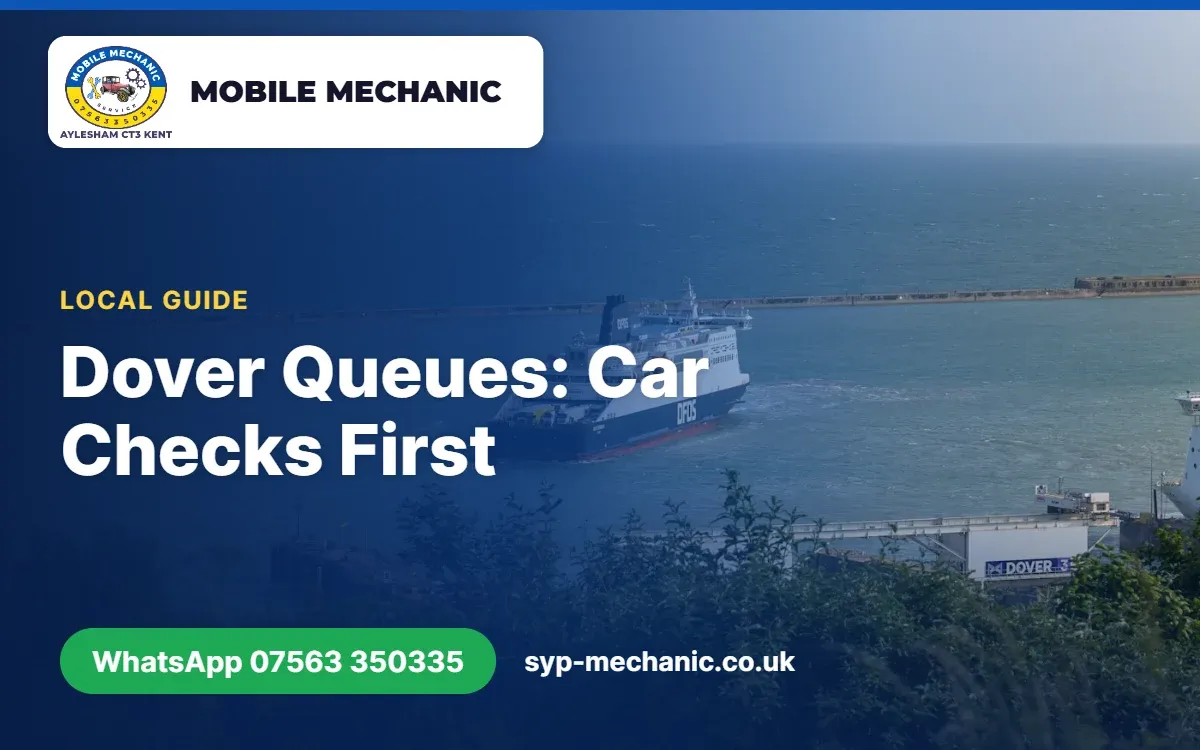
Operation Brock and Dover Queues: Car Checks Before You Go
Written by Petro Olekhnovych, mobile mechanic in Aylesham, Kent
Before you head for Dover or the Channel Tunnel at a busy time, do some simple Operation Brock car checks: plenty of fuel, oil and coolant at the right levels, a healthy battery and good tyres. Pack food, water and any medication too. Operation Brock and the queues around it can mean long, slow waits, and a car that is only just coping can let you down in the middle of one.
What is Operation Brock?
Kent Prepared describes Operation Brock as “a series of traffic management measures in Kent” used during cross-Channel disruption. GOV.UK says it runs on the M20 between junction 8 (Maidstone) and junction 9 (Ashford).
When it is active, Kent Prepared says lorries heading for the Port of Dover or Eurotunnel must enter at junction 8. GOV.UK explains that cars and other traffic use a contraflow on the London-bound side, so two lanes stay open each way. The contraflow has a 50mph limit.
National Highways has also put the contraflow in place ahead of busy holiday periods, such as Easter 2025, because of expected high passenger numbers at the Kent ports.
What is Operation TAP?
Closer to Dover there is TAP, which Kent Prepared says stands for Traffic Assessment Protocol. Freight is held in the left-hand lane of the A20 coastbound into Dover, so other traffic can use the second lane.
Even with these measures, queues at busy times can be long. Plan for it.
Need a mobile mechanic in East Kent?
Based in Aylesham, we come to your home or work across Canterbury, Dover, Deal and nearby villages.
WhatsApp for a free quote Call 07563 350335
Labour £30 to £50 per hour depending on the job. Send your reg number and we will reply with a price before any work starts.
Car checks before you set off
Kent Prepared advises checking your tyres, lights, fuel, oil and water before you set off. Here is what that means in practice.
Fuel. National Highways tells drivers to make sure they have plenty of fuel. The AA adds that sitting in traffic increases fuel use. Fill up before you join the M20 or A20, not when the light comes on.
Engine oil. The RAC says the oil level should be between the minimum and maximum markers. If the oil pressure light comes on at any point, stop safely and switch off.
Coolant. Slow queues give the engine little cooling airflow. Check the coolant level in the expansion tank when the engine is cold. If the temperature gauge goes into the red, the RAC says to pull over when safe, switch off and leave the engine to cool for at least 30 minutes. Never open the cap on a hot engine, as it is under pressure. Our guide to car overheating has the full roadside steps.
Battery. A queue can mean lots of stops and restarts. The RAC lists slow or weak cranking, dim lights and the battery warning light as signs of a weak battery. It says batteries generally last between three and five years. If yours shows these signs, get it tested before the trip.
Tyres. The RAC suggests setting pressures for the load you are carrying, using the sticker in the fuel flap or driver’s door frame. The legal minimum tread is 1.6mm across the central three-quarters of the tyre, according to the Highway Code.
Lights and screenwash. Check every bulb works and top up the screenwash.
For a longer trip, our car checks before a long drive cover more ground.
Engine on or off in a queue?
Highway Code rule 123 says you should not leave the engine running unnecessarily while stationary. However, it allows the engine to run when you are stationary in traffic.
If you are going nowhere for a long time, Kent County Council advises turning off when it is practical and safe. It says modern batteries do not need the engine running constantly.
The RAC advises turning lights and electrics off before switching off the ignition. Leaving them on with the engine off can drain the battery.
What to carry
Kent Prepared urges drivers to carry enough food, water and regular medication for a long wait. It also advises using the toilets at services before joining the queue, as there are none on a live carriageway.
The AA says that if traffic is at a complete standstill, you should not leave your car to see what is happening ahead.
National Highways advises checking with your travel operator before setting off and allowing extra time. During closures, follow the diversion signs rather than your sat nav.
Heading abroad? Our post on driving to France from Dover or Folkestone covers the documents and kit you need.
How we can help
We are a mobile mechanic based in Aylesham, and our mobile mechanic service in Dover can check your car at home before you travel. We also cover Folkestone, Deal, Canterbury and the villages in between.
We can do an oil and filter change, check coolant levels, replace a water pump and look at brakes, pads and discs. If a warning light is on, or you suspect a weak battery, we can come out and diagnose the cause, then tell you what it needs.
Labour is £30-£50 per hour, depending on the job and its difficulty. Parts are extra. We agree the price on WhatsApp before any work starts.
Frequently asked questions
Does Operation Brock affect cars?
Yes. Cars on the M20 between junctions 8 and 9 use the contraflow on the London-bound side while lorries are held.
How much fuel should I have?
National Highways says “plenty”. A full tank before you join the queue is the safe choice.
Should I switch off my engine in a queue?
The Highway Code allows it to run in traffic. If you are stationary for a long time, switching off when safe saves fuel.
What if my car overheats in the queue?
Pull over when it is safe, switch off and let it cool. Do not open the radiator cap while hot.
Need help? Send a WhatsApp to 07563 350335 with your car’s make and model and we’ll come to you.
Need a mobile mechanic in East Kent?
Message us on WhatsApp with your reg and postcode for a price before any work starts.
WhatsApp for a free quote Call 07563 350335
Labour £30 to £50 per hour depending on the job. Send your reg number and we will reply with a price before any work starts.
Sources
- Kent Prepared: FAQs (Operation Brock, TAP and queue advice)
- National Highways: Operation Brock contraflow for Easter 2025
- GOV.UK: Operation Brock is activated on the M20
- Le Shuttle: Operation Brock
- AA: What to do if you get stuck in traffic
- RAC: How to prepare for a road trip
- RAC: Car overheating
- RAC: Signs your car battery is low
- RAC: How long do car batteries last?
- RAC: Avoid car breakdowns with our top tips
- The Highway Code: Rule 123
- The Highway Code, Annex 6: Vehicle maintenance
- Kent County Council: Don’t be idle, switch off your engine
